Ending California's ADU Impact Fee Cliff Over 750 Sq Ft
The California rule that kills 750 sq ft ADUs
Here's the rule: build an ADU at 749 square feet, and you pay $0 in impact fees. Build the exact same home at 750+ square feet, and you can owe thousands.
One square foot. Thousands of dollars.
That extra cost discourages homeowners from building family-sized ADUs between 750 and 850 square feet. It makes housing more expensive for folks who could really use more options. And it hurts housing providers as much as renters.
We’ve got a bill in the legislature this year called SB 1117 that fixes all this. It needs your support.
The $5,775 impact fee at 751 square feet
In a recent video, I visited a real ADU in Alameda County.
The owner, Martin, built a detached, two-bed, two-bath ADU behind his property. He stopped it at 745 square feet.
Not because that's what fit his lot best. Because six more square feet would have triggered thousands of dollars in impact fees he'd never recoup in rent.
The county's own ADU handout lists a $5,775 flat Park Dedication Fee for any ADU 750 square feet or more. Under 750, that line item is $0. The county's own guidance even tells homeowners outright: "Consider an ADU smaller than 750 square feet to reduce fees."
And Martin isn't an outlier. This is happening all over California.
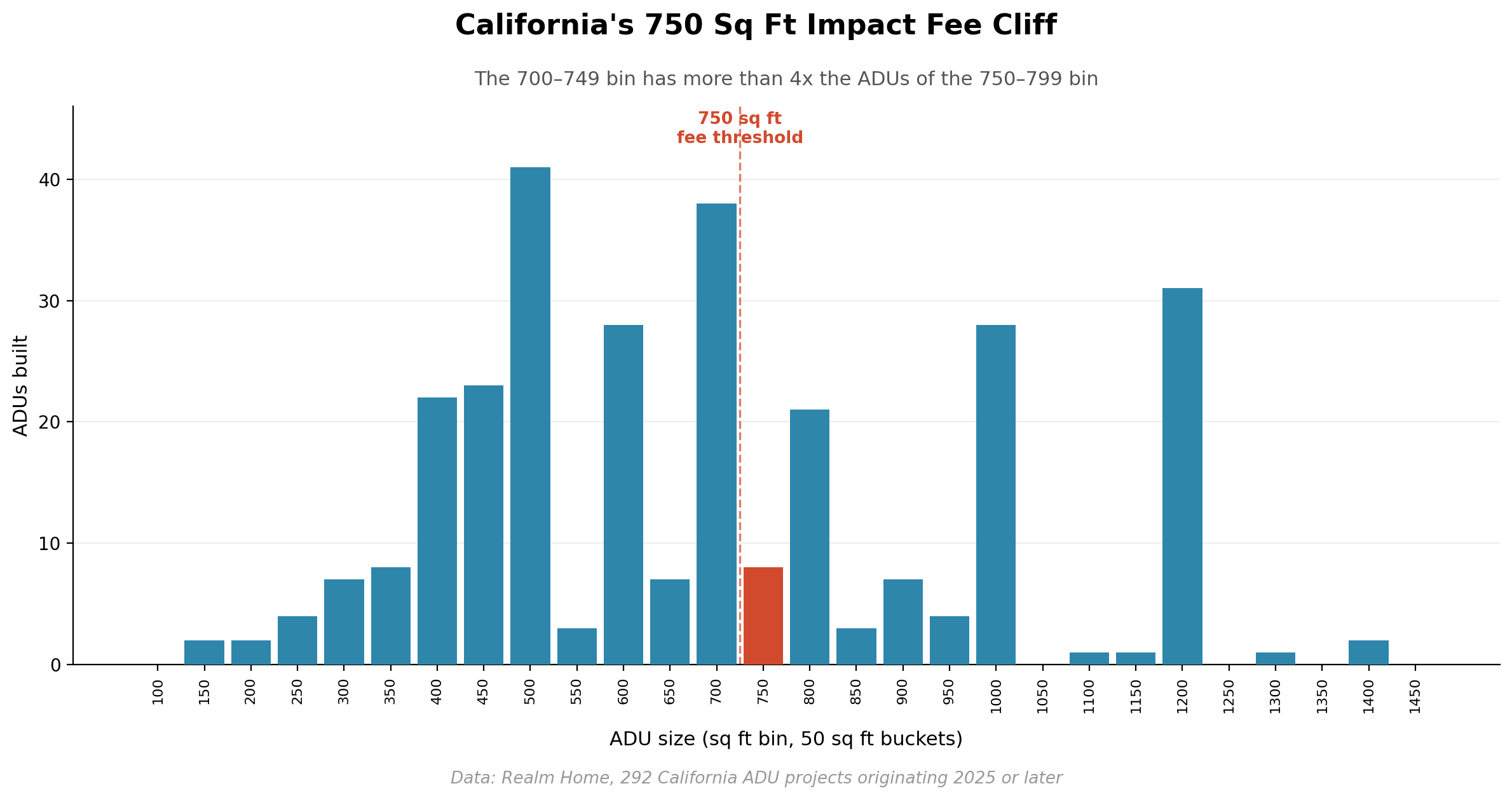
Our sponsors at Realm Home shared this data — 292 California ADU projects they've worked on since 2025. Look at the bar right at 750. The steep dropoff from 700-749 sq ft ADUs and 750-799 sq ft ADUs says it all.
38 ADUs land in the 700–749 bucket. Just 8 land in 750–799, right next door. That's not what a natural distribution looks like — it's what a fee cliff looks like.
The state requires every jurisdiction to allow detached ADUs up to 800 square feet. That size should be common. Instead, it's one of the rarest, because homeowners are designing around the impact fee cliff instead of around what their family actually needs.
Contractors and homeowners say the quiet part out loud in their own paperwork. Bid after bid in Realm’s data includes lines like "staying under 750 square feet to avoid impact fees."
What this impact fee cliff costs a real family in Costa Mesa
I talked to Steph Gutierrez of West Coast ADU, who's been testifying in Sacramento with me this year along with organizations like Casita Coalition and California YIMBY.
She shared a client story: a homeowner planning two ADUs, one for each set of grandparents. Both landed just over 751 square feet.
One square foot over the line meant $12,000–$14,000 in impact fees per unit. Almost $30,000 combined.
They redesigned smaller instead — even though 751 or even 800 square feet would have fit a two-bed, two-bath comfortably.
How SB 1117 fixes the impact fee cliff
Instead of charging backwards-looking impact fees on the entire ADU once it crosses 750 square feet, SB 1117 says cities can only charge fees on the square footage above 750.
That means:
More homeowners can build the ADUs they actually need
More family-sized homes get built
Housing costs come down
Local governments still collect impact fees — without a penalty that stops projects from happening at all
Cities are already collecting almost nothing — and refunding fees they never spent
This doesn't defund cities. Look at the chart again: cities are collecting almost no impact fee revenue in the 750–799 range today, because almost nobody builds there.
And here's the part that should embarrass anyone arguing these fees are essential: last year, Alameda County had to refund $1,519,162 in unspent park dedication impact fees back to developers. State law requires fees to be returned if they sit uncommitted for more than five years — and that's exactly what happened. The county collected money it didn't have a plan to spend.
You can Help by Signing this petition
The bill is working through committees, facing more resistance than a fix this reasonable should.
Add your name and tell the Assembly to vote YES on SB 1117. Every signature helps show lawmakers that Californians want practical fixes that make it easier to build homes.
Want the full story — the data, Steph's testimony, all of it? Watch the video here